
Slab selection rarely gets the attention it deserves during the early stages of a build. Most homeowners hear “concrete slab” and assume the details sort themselves out from there. But the type of slab underneath a home shapes how it responds to soil movement, how long the pour takes, and whether the structure stays level when the ground decides to shift. The waffle pod slab system has become the dominant foundation choice across much of suburban Australia — not because it is fashionable, but because it handles conditions that older slab designs were never properly built for.
Why Reactive Soil Changes Everything
The clay soils covering large parts of Victoria, South Australia, and Queensland shrink when dry and swell when wet. A slab sitting directly on that ground moves with it — sometimes unevenly, cracking walls and jamming door frames years after the build appears complete. Waffle pod slabs are engineered to sit above ground level on a grid of concrete beams, which means the soil beneath can shift without the slab surface tracking every movement. That gap between slab and soil is not an accident; it is the entire point.
What The Pods Actually Do
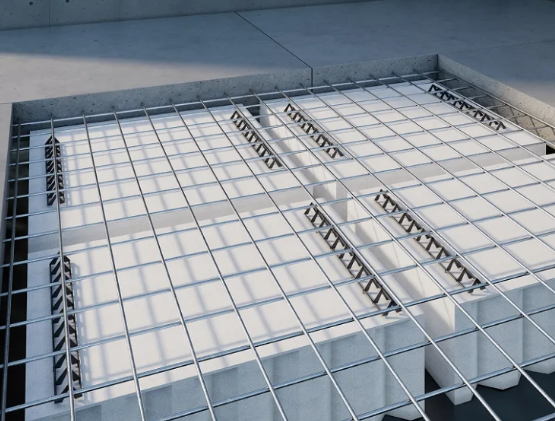
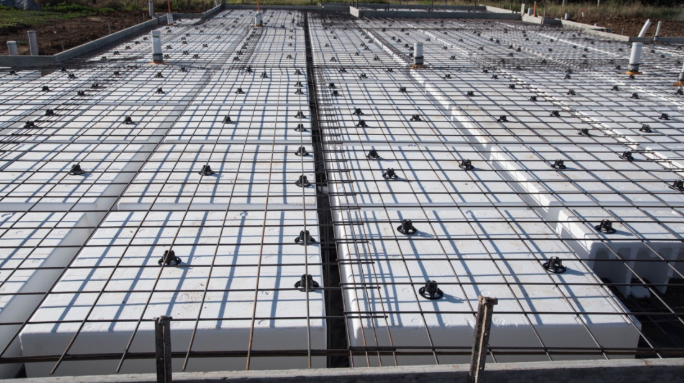
The polystyrene pods placed within the beam grid are not structural — they are formwork that stays in place permanently. They create the characteristic waffle pattern on the underside of the slab while dramatically reducing how much concrete the pour requires. Less concrete means less weight bearing down on reactive soil, which itself reduces the load that ground movement has to overcome before a slab starts to deflect. The pods are a passive detail with an active structural consequence.
The Edge Beam Problem On Older Slabs
Waffle pod slab systems use a perimeter edge beam that runs continuously around the base of the building. On older raft slabs, the perimeter was often the weakest point — the place where differential movement first showed up as a crack or a settled corner. The deeper edge beam on a waffle pod design resists that differential movement more effectively, particularly on sites where one side of the building is in shade and the other faces full afternoon sun, drying the soil unevenly across the footprint.
Speed On Site That Changes The Schedule
Excavation on a traditional stiffened raft requires cutting trenches for every internal beam, a slow and labour-intensive process that depends heavily on soil conditions. Waffle pod preparation works differently — the ground is levelled, a plastic membrane is laid, and the pod and beam grid is assembled above it. The whole setup is faster to prepare, which means the pour happens sooner and the frame can follow more quickly. On a project where the construction loan is running, that time difference has real consequences.
Where Engineers Still Specify Raft Slabs Instead
The waffle pod slab system is not a universal solution, and understanding when it is not appropriate matters as much as knowing its strengths. On steeply sloping sites, cut-and-fill sites, or ground with significant point load requirements — such as those carrying heavy masonry or multi-storey loads — a raft slab or pier-and-beam foundation is often the correct specification. The waffle pod excels on flat to gently sloping residential sites with reactive clay. Outside that envelope, it can be pushed into applications it was not designed to handle.
Termite Management Beneath The Slab
The polystyrene pods used in waffle slabs create a concern that is sometimes glossed over in builder conversations: termites can nest within the void spaces if the perimeter barrier is compromised or poorly installed. The Australian standard for termite management requires a continuous chemical or physical barrier at the slab perimeter, and this detail is non-negotiable on waffle pod construction. Properties in high-termite-pressure areas — which includes most of coastal and regional Queensland and NSW — need that barrier inspected and maintained, not just installed once and forgotten.
What Homeowners Never Think To Ask
Most people buying a new home in Australia do not know what type of slab their home sits on. They know the floor is level and concrete is involved. The questions worth asking are about the site classification — the geotechnical rating that determines what slab design the engineer specified — and whether the slab design matches that classification. A slab designed for a moderately reactive site placed on a highly reactive one will move. The classification is documented, the slab design is documented, and comparing the two takes minutes.
Conclusion
The waffle pod slab system earns its place on Australian residential projects because it was designed around the specific way Australian soil behaves — not adapted from overseas practice or carried over from an era when reactive clay was less understood. Its strengths are real and site-specific, and so are its limitations. Builders and homeowners who understand both are in a far better position than those who treat the slab as a background detail to be sorted out by someone else before the frame goes up.